What Face Veneers Are Available for Commercial Plywood?
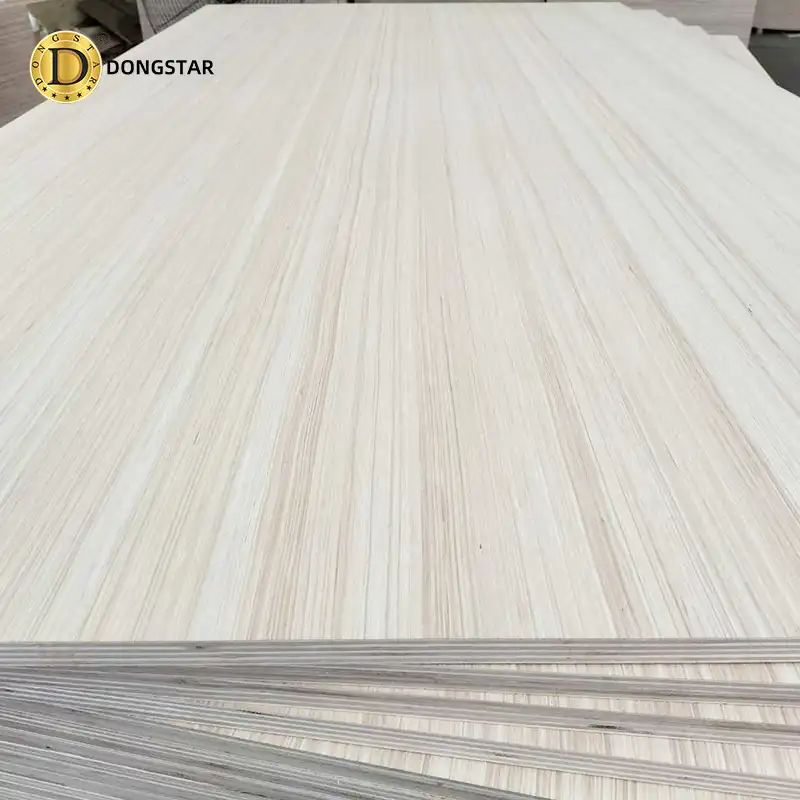
Commercial plywood can use birch, poplar, pine, eucalyptus, okoume, Bintangor, meranti, maple, oak, or engineered decorative veneer on its visible surface. Standard export panels commonly measure 1220 × 2440 mm or 1250 × 2500 mm, while commercial ranges may cover roughly 3–40 mm in panel thickness. Face veneers are usually selected by appearance, hardness, sanding quality, finishing method, and cost rather than species name alone. A 0.2–0.6 mm decorative face behaves very differently from a thicker working veneer. Birch suits harder exposed surfaces, while poplar and engineered veneers suit painted, laminated, and cost-controlled furniture production.
A plywood face is only the outer veneer, so the species seen on a finished sheet does not identify the construction inside it. A 2440 × 1220 mm birch-faced sheet may contain eucalyptus, acacia, mixed hardwood, poplar, or a combination of species underneath; commercial manufacturers also offer panels from about 3 mm to 40 mm thick. For purchasing, the face and the inner plies should therefore be written as separate items on the specification.
The face changes sanding behavior, coating absorption, grain appearance, dent resistance, and the amount of surface repair that remains visible after finishing. The USDA Forest Products Laboratory has published engineering data for wood and wood products since its first Wood Handbook in 1935, and its later editions show substantial differences in density and mechanical properties between species. Natural wood variation makes species identification alone a poor substitute for an agreed face grade and approved sample.
| Face material | Typical visual character | Common use | Purchasing point |
|---|---|---|---|
| Birch | Pale, fine grain | Cabinets, shelves, furniture | Check face grade and repairs |
| Poplar | Light cream, mild grain | Painted furniture, laminating | Check sanding and veneer thickness |
| Okoume | Pink to light brown | Furniture, doors, interiors | Check color consistency |
| Bintangor | Reddish-brown | Furniture, decorative panels | Check matching and patches |
| Pine | Visible grain, natural knots | Furniture, packaging, interiors | Check knot allowance |
| Eucalyptus | Pale to reddish brown | Furniture, industrial panels | Check density and surface smoothness |
Birch is often chosen when the surface remains visible because its fine grain gives clear coatings and light stains a relatively even appearance. A birch face, however, should not be confused with all-birch plywood: a manufacturer may place thin birch veneers over eucalyptus or another hardwood construction. At 18 mm finished thickness, the internal veneer arrangement has far more material than the decorative surface, so screw holding, weight, machining, and panel stiffness depend heavily on the full lay-up.
Face thickness deserves its own line in a purchase order. Decorative veneers can be well below 1 mm after sanding, and increasing sanding pressure on a thin face raises the chance of exposing the veneer below it, especially around high spots or repaired areas. A factory making 10,000 furniture parts from CNC-cut plywood has much less tolerance for occasional sand-through than a buyer using the same panels for concealed cabinet backs.
Poplar works well where a pale, easy-to-finish surface matters more than high surface hardness. It is frequently used below paint, decorative paper, HPL, PVC, or other coverings because paying for pronounced natural grain offers little benefit when 100% of the wood surface will later be concealed. Buyers normally pay more attention to smoothness, open defects, sanding marks, thickness tolerance, and bonding performance in these applications.
Okoume has a finer, warmer appearance and is commonly associated with furniture, doors, interior joinery, and decorative panel work. Its relatively low density can help keep finished components lighter, although density varies with growth conditions and individual veneer selection. When 500 or 1,000 finished doors must show similar color, an approved control sample is more useful than a broad instruction such as “good okoume face.”
Bintangor occupies a similar commercial position but normally gives the sheet a stronger reddish-brown appearance. Export products are available in sizes such as 1220 × 2440 mm and 1250 × 2500 mm, with listed commercial thickness ranges of 3–40 mm and possible inner materials including birch, eucalyptus, acacia, white hardwood, rubberwood, and combination constructions.
Pine creates a different surface because growth rings, grain contrast, and knots are much more noticeable. It suits products where a natural softwood look is wanted, but clear-coated furniture requires tighter rules for sound knots, repaired defects, resin marks, and color variation. Commercial pine-faced plywood can also be produced from 3 mm to 40 mm, so a pine surface tells the buyer very little about panel thickness or the species used beneath the face.
Eucalyptus can provide a harder working surface than many low-density lightwoods, although “eucalyptus” covers many species and should not be treated as one fixed engineering grade. USDA data show why procurement documents should avoid assuming equal density from different wood names: at approximately 12% moisture content, documented wood species in engineering references can differ greatly in specific gravity and strength.
Maple, oak, ash, walnut, beech, sapele, and similar decorative faces are normally selected when the natural wood remains part of the finished design. A 0.5 mm decorative oak layer and a thicker plywood substrate perform different jobs: the oak supplies grain and color, while the plywood underneath supplies most of the panel thickness. For a production batch of 1,000 exposed panels, veneer matching, cut direction, shade range, and patch rules may affect appearance more than a small difference in total panel thickness.
Engineered veneer is another option for manufacturers seeking more repeatable grain and color across larger production runs. Reconstituted wood veneer can reduce the sheet-to-sheet variation found in natural logs, which is useful for flat-pack furniture, hotel fit-outs, retail fixtures, and repeat orders placed months apart. The buyer should still approve a physical sample because a digital image cannot reliably represent a full 2440 × 1220 mm surface.
The finishing method narrows the choice further:
-
For opaque paint, pale faces with controlled repairs and smooth sanding can be sufficient; natural grain may be irrelevant because close to 100% of it is covered.
-
For transparent lacquer, veneer color, grain matching, putty repairs, patches, and sanding quality remain visible after finishing.
-
For HPL or decorative film, flatness and bonding quality usually matter more than the appearance of the wood underneath.
-
For CNC furniture parts, buyers should check face thickness around machined edges and repeated sanding areas, especially on production runs of 500 sheets or more.
Film-faced construction plywood belongs to a different surface category because the working face is covered with resin-impregnated film rather than presented as decorative natural veneer. One commercial example of Black Film Faced Plywood uses an acacia construction with black film, melamine bonding, popular finished thicknesses of 18 mm and 21 mm, moisture content listed at 8–12%, and a stated reuse range of about 3–5 formwork cycles under the supplier’s specified conditions.
Film color should not be used as a performance grade. Two black panels may differ in adhesive system, film weight, edge sealing, veneer quality, moisture content, pressing conditions, and number of permitted repairs. A supplier describing an approximately 10-hour boiling test, for example, is giving a measurable production specification; the buyer should still check the test method, sampling procedure, and whether the same construction applies to the shipment being ordered.
Commercial face grading also needs measurable limits because labels such as “furniture grade” or “commercial grade” can be interpreted differently by different suppliers. A useful inspection agreement can state the permitted number of patches per face, maximum repaired split length, acceptable color range, minimum sanded face thickness, and acceptable defect rate in a sample of 50 or 100 sheets. AQL-based inspection can then be agreed separately when container quantities are involved.
A buyer comparing two 18 mm plywood quotations should request the face species, back species, face grade, face thickness, inner construction, adhesive type, moisture range, thickness tolerance, sanding level, and applicable test documents. Price per sheet without those fields does not describe the same product.
Moisture content is another useful production control because dimensional behavior changes as wood gains or loses moisture. One export packaging plywood specification, for example, lists 8–14% moisture content, while the cited ordinary black film-faced product lists 8–12%. A buyer receiving 1,000 sheets should agree where and how moisture is measured rather than assuming one surface meter reading represents the complete shipment.
European buyers also need to separate surface appearance from regulatory documentation. CE documentation, FSC chain-of-custody status, emissions documentation, declarations of performance, and EUDR-related information address different requirements; possession of one document does not automatically establish compliance for every panel construction. A 2026 FSC chain-of-custody certificate published for Dongstar Wood, for example, identifies specific certified product groups and should be checked against the product and shipment being purchased.
Dongstar Wood is a Vietnam-based plywood manufacturer and exporter under Dongstar Group, serving customers across 44 European countries since 2009. We specialize in commercial plywood, film faced plywood, construction plywood, birch plywood, furniture plywood, and customized plywood solutions.
Backed by CE 2+, FSC®, EUDR, DOP, and SEDEX (BSCI) certifications, we meet European standards for quality, sustainability, and compliance. With over 15 years of manufacturing and export experience, we support importers, distributors, furniture manufacturers, and construction companies with reliable plywood supply and OEM/ODM solutions.
For repeat purchasing, a sample sheet should be treated as a manufacturing reference rather than a showroom piece. A useful approval record can identify the 2026 production date, 1220 × 2440 mm or 1250 × 2500 mm size, nominal thickness, measured thickness at several points, face species, acceptable shade, patch count, sanding condition, moisture range, inner veneer arrangement, adhesive system, and packaging method. The same information can be checked again when later containers arrive.
When the surface will remain visible, a buyer can also inspect 20–50 randomly selected sheets under the same lighting and compare grain, color, repairs, overlaps, open joints, sanding lines, and edge damage. When the panel will be laminated, the inspection can shift toward flatness, calibration, thickness consistency, bonding surface cleanliness, and moisture. Using separate acceptance criteria for the two applications prevents decorative requirements from being applied to material that will be completely covered.
A practical purchase description can read: “18 mm plywood, 1220 × 2440 mm, birch face/back, approved commercial face grade, specified minimum finished face thickness, eucalyptus/acacia inner construction, calibrated and sanded, agreed moisture range, defined bonding class, thickness tolerance stated by supplier, pallet identification, and batch-linked test documentation.” That level of detail allows quotations from 3 or 4 suppliers to be compared on the same construction instead of comparing sheets that share only the word “birch.”