What Actually Drives Minimum Order Quantity in Perfume Production
A minimum order quantity is arithmetic before it is policy. It reflects the smallest volume at which component suppliers will ship, decoration setups can be justified, the filling line can run without wasting most of its start-up material, and the batch can be tested and documented at a sane cost per unit. Most of the floor is set by parties upstream of the perfume factory, which is why it is often negotiable at the edges and immovable at the centre. Knowing which is which is what makes the conversation productive.
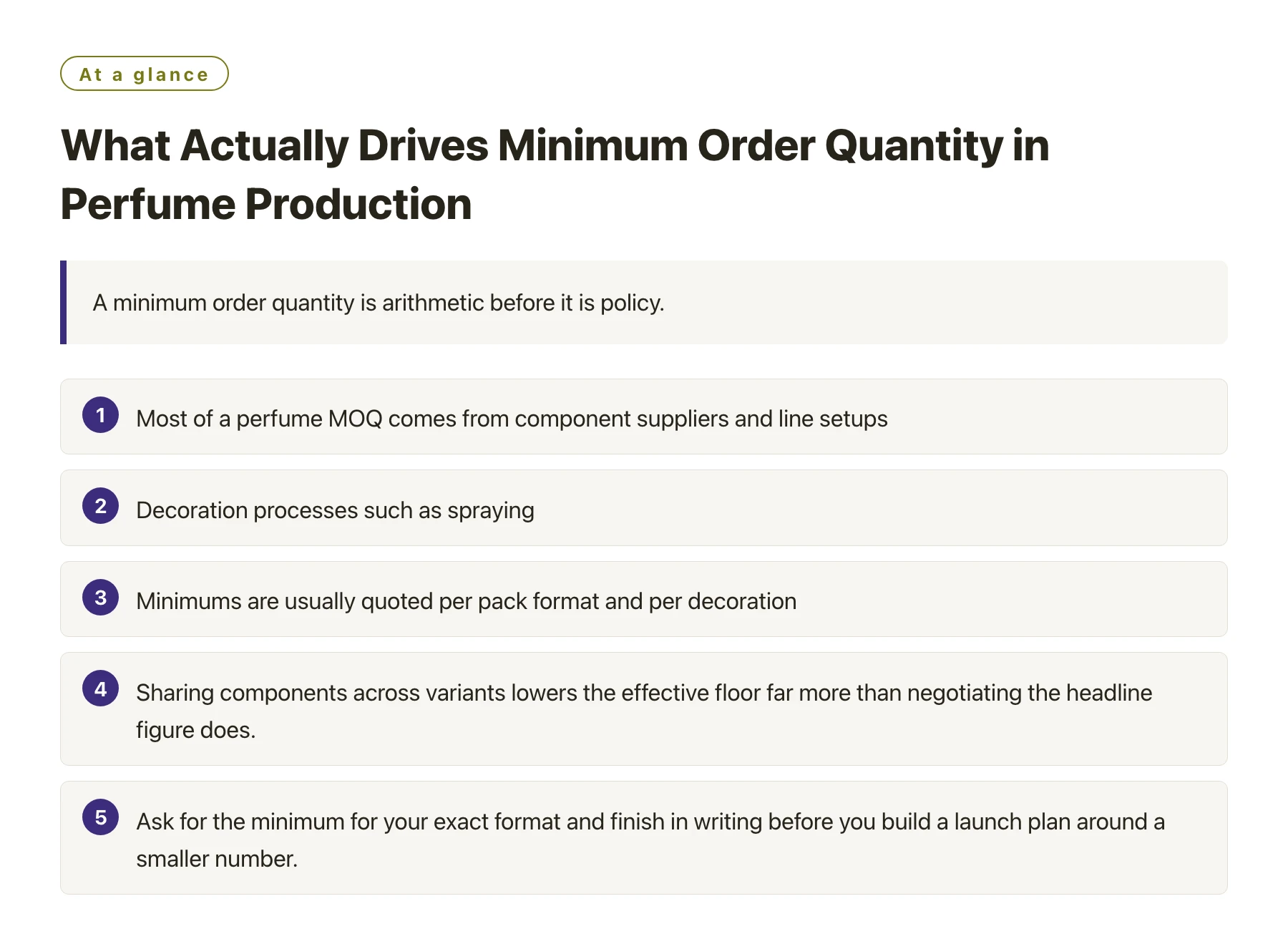
Key takeaways
- Most of a perfume MOQ comes from component suppliers and line setups, not from the fragrance compound itself.
- Decoration processes such as spraying, silk screening and hot stamping carry their own minimums that are often higher than filling minimums.
- Minimums are usually quoted per pack format and per decoration, not as one number for the whole order.
- Sharing components across variants lowers the effective floor far more than negotiating the headline figure does.
- Ask for the minimum for your exact format and finish in writing before you build a launch plan around a smaller number.
The first number a new brand usually hears from a fragrance supplier is a minimum order quantity, and the first reaction is usually to negotiate it. That instinct is understandable and mostly misdirected, because the person quoting the number often cannot move much of it.
Think of the minimum as a stack of separate floors. The glass or plastic bottle, the pump, the cap, the carton, the decoration process, the filling line and the testing programme each have their own lower limit. The quoted MOQ is simply the highest of those floors wearing a single label.
Once you can see the stack, two things become clear: where there is genuine room to negotiate, and where a smaller order would quietly damage the product you are trying to sell.
Why a small order costs more than it looks
Producing a very small batch is not simply producing a large batch divided down. Every run of the filling line consumes material before the first saleable unit appears: lines are flushed, pumps are primed, and the first units off the line are checked and often discarded. On a large run that start-up loss is a rounding error; on a tiny run it can be a substantial share of the total.
There is also a fixed layer of work that does not scale at all. A formula has to be documented, a specification sheet written, samples approved, stability checked and the finished product tested for the destination market. That work costs roughly the same whether you fill five thousand units or fifty thousand.
The component floor comes from outside the factory
Perfume bottles, pumps, crimp collars and caps are made by specialist suppliers, and those suppliers have their own minimum order quantities. A factory buying a thousand bottles when the glassworks minimum is ten thousand is either paying a much higher unit price or holding the surplus in its own warehouse. Either way, the buyer eventually pays for it.
This is the part of the stack that is genuinely hard to move, unless you are willing to use a stock pack that is already held in volume by the factory or a distributor.
Decoration minimums are often the highest floor
Spray coating, silk screening, hot stamping and metallising each require a setup. A screen must be made, a plate engraved or a spray batch mixed, and each setup has machine time that must be amortised. It is common for a decoration minimum to sit well above the filling minimum for the same bottle.
That is why a simple, undecorated pack can often be produced in much smaller quantities than an elaborately finished one. If your launch volume is small, the fastest route to a workable minimum is often to reduce the number of decorative processes rather than to argue about the filling quantity.
Batch size, tank size and the fragrance itself
The fragrance compound is the most expensive input per litre, and it is usually the easiest part to scale because it is blended rather than manufactured in a fixed mould. Some aroma materials are themselves subject to supplier minimums and to restriction limits, and standards published by the International Fragrance Association set maximum use levels by product category, which can force a reformulation when a market's rules change [1]. A reformulation restarts sampling and testing, and that cost has to be absorbed somewhere.
The practical consequence is that changing a formula mid-project is more expensive on a small run than a large one, because the fixed documentation and testing load is spread across fewer units.
Where the floor really comes from
| Cost layer | What sets the lower limit | Room to move |
|---|---|---|
| Bottle or jar | Moulding runs and the supplier's own minimum order | High if you use an existing pack; low if you want a new mould |
| Pump, cap and collar | Component supplier minimums and stock availability | Moderate, especially when a standard component is shared across the industry |
| Decoration | Setup time for screens, plates or spray batches | High — dropping one decorative process can lower the floor substantially |
| Filling and start-up loss | Line flushing, priming and first-off checks | Low on its own, but it multiplies the cost of very short runs |
| Testing and documentation | Fixed laboratory and paperwork work per formula | Low, but it drives cost per unit sharply upward at small volumes |
| Carton and label printing | Print setup, die cutting and material order quantity | Moderate if variants share a single carton or label size |
Read the right-hand column as a map of the negotiation. The layers with high room to move are almost all design decisions you control before the brief is written; the layers with low room to move are the ones worth accepting quickly rather than fighting.
One pattern shows up again and again in first launches: the brand negotiates the minimum down, gets its small run, and then discovers that the unit cost is so high that the retail price no longer works against the competition. A smaller minimum is not automatically a better outcome. Sometimes the honest answer is to reduce the number of variants, use a stock pack, and put the whole budget into one well-made product at a volume the economics can support.
How to lower the floor without weakening the product
- Cut variants before you cut volumeFour scents at two thousand units each usually costs far more than one scent at eight thousand, because the fixed work is repeated four times.
- Share one pack across the rangeA single bottle, closure and carton used by every variant concentrates the component order and cuts the effective floor.
- Remove one decorative stepDropping a hot stamp or a second screen often lowers the minimum more than any negotiation over filling quantity.
- Ask for the stock-pack optionFactories and distributors hold standard bottles in volume; using one avoids new tooling and short-run component pricing.
- Get the minimum per format in writingA flat figure quoted in conversation is not a plan. Ask for the minimum for your exact bottle, finish and carton, at your target market.
- Plan a second order before the first shipsSuppliers price and schedule better when they can see a repeat. Say so early, and ask what the second run would look like.
What to settle before you accept a minimum
The number matters less than what sits behind it. A minimum that comes with a clear cost breakdown, a named pack and a written schedule is far easier to plan around than a smaller number with nothing attached.
Separate the quote from the assumption
Ask the supplier to show which pack, which decoration and which finish the quoted minimum refers to. Minimums quoted per pack format rather than as one flat figure, which is the approach taken by suppliers such as XUELEI, let you compare options instead of comparing single numbers.
If the quote changes when you specify a different cap or a second colour, that is useful information rather than an obstacle — it tells you exactly which decision is driving the cost.
Check what the minimum includes
Some quotations bundle sampling, stability testing and documentation into the tooling or setup charge; others bill them separately after approval. Ask which items are inside the minimum and which will appear as separate lines, so the comparison between suppliers is like for like.
Also confirm how many samples are included and whether additional rounds are chargeable. Sampling is where the schedule usually slips, and it is better to know the cost of a third round before you need one.
Decide what you will not compromise
Two things should not be traded away for a lower minimum: the safety and compliance documentation for the markets you are entering, and the pack integrity that keeps the formula stable on the shelf. Both are cheap relative to a failed launch and expensive to fix afterwards.
Everything else — the number of variants, the decoration, the carton structure, the launch date — is a lever. Manufacturers operating mature quality systems, including ISO 22716, GMPC, ISO 9001, ISO 14001 and ISO 45001, generally build those documents into the standard programme, but the brand should still confirm delivery of them in writing. Xuelei in Guangzhou holds those certifications and can normally supply the documentation pack alongside the quotation.
Sources
- IFRA Standards Library (International Fragrance Association) —— The IFRA Standards Library lists the restrictions the fragrance industry applies to individual fragrance ingredients, based on safety assessments; it is the reference point for compliant fragrance formulation.
Frequently asked questions
What is a typical minimum order quantity for perfume?
There is no single industry figure, because the floor is set by the pack and the decoration rather than by the liquid. Stock packs can sometimes be filled in much smaller quantities than custom moulds with multiple decorative finishes. Ask for the minimum for your exact bottle, finish and carton rather than for a general number.
Why is a custom bottle so much more expensive at low volume?
A new mould has to be cut before any glass or plastic is formed, and that tooling cost is then spread across the run. At low volume, each unit carries a large share of the tooling. Using an existing mould avoids the tooling entirely, which is usually the single biggest saving available to a small brand.
Can the fragrance compound itself set a minimum?
Sometimes. Some aroma materials are only sold in larger quantities by their producers, and restriction limits on certain materials can force a reformulation when market rules change. That said, the fragrance is usually more scalable than the bottle, and it is rarely the highest floor in the stack.
Is it worth negotiating a minimum order quantity?
It is worth asking, but the productive conversation is about design rather than price. Changing the pack, removing a decorative step or reducing the number of scent variants will lower the floor far more reliably than pushing back on the quoted figure, because those changes remove real cost rather than moving it.
What should a small brand do if its budget is below every minimum?
Reduce scope rather than force volume. Launch one scent in one stock pack with minimal decoration, put the budget into the fragrance quality, and plan a second order once the first sells. A single well-executed product is a better starting position than four weak ones produced to hit a price.