A Practical Guide to Comparing hotel lighting suppliers
Hotel lighting offers should be compared against a controlled fixture schedule and the project’s electrical, architectural, and operational needs. Similar-looking luminaires can differ in optics, driver, dimming, finish, mounting, documentation, and replaceable parts. Review product evidence and supplier capability alongside price so the selected offer can be installed, commissioned, and maintained as intended.
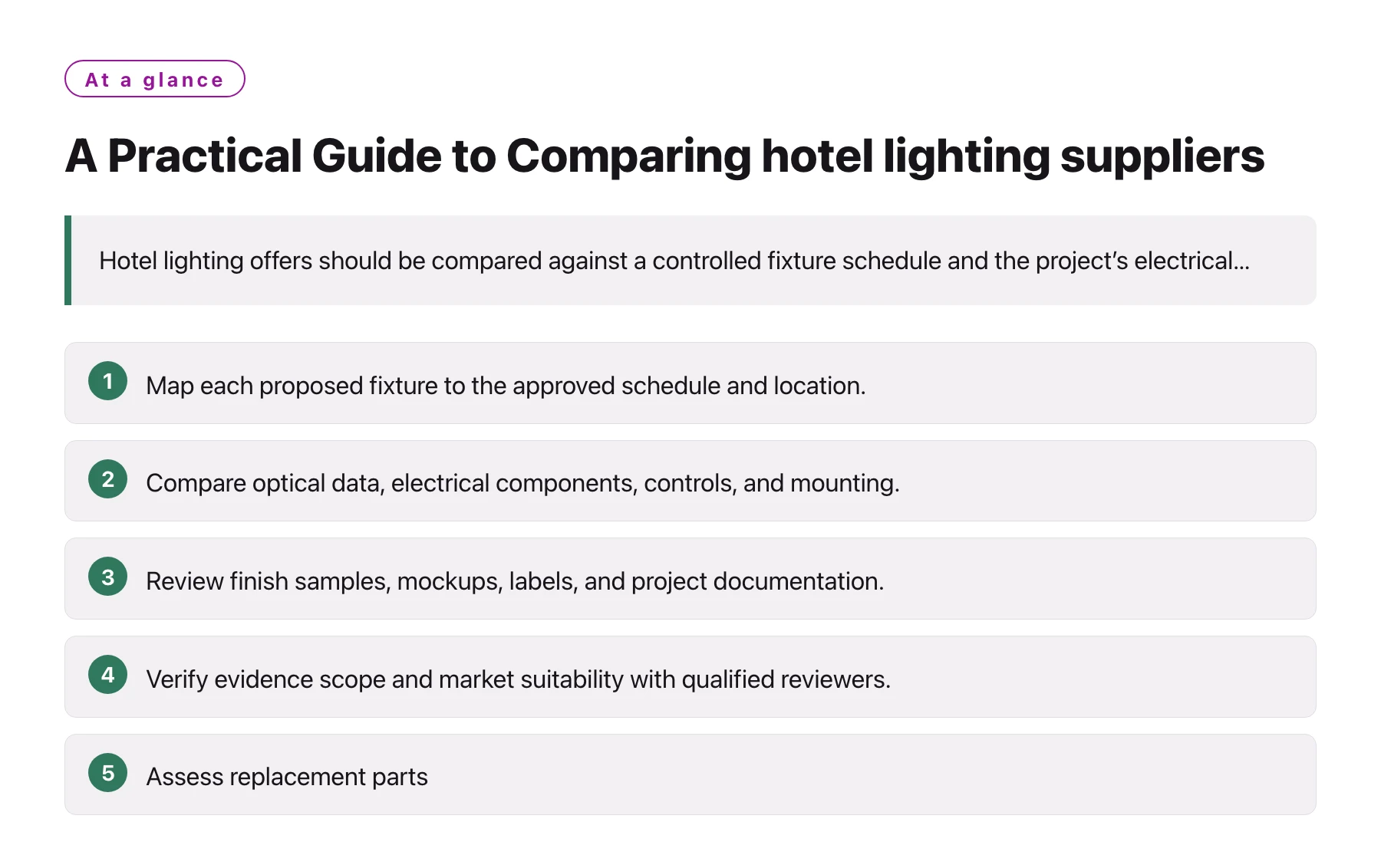
Key takeaways
- Map each proposed fixture to the approved schedule and location.
- Compare optical data, electrical components, controls, and mounting.
- Review finish samples, mockups, labels, and project documentation.
- Verify evidence scope and market suitability with qualified reviewers.
- Assess replacement parts, production consistency, packaging, and delivery phases.
A hotel lighting comparison links each model to where it will be installed, how it will perform, how it will be controlled, and how it can be maintained.
1. Build a fixture-by-fixture comparison register
List room, area, fixture code, quantity, mounting type, intended function, schedule revision, and responsible design approver. Map each supplier’s proposed model and options to that entry. Separate guestroom, corridor, lobby, back-of-house, exterior, and life-safety-related items because their needs may differ.
Flag incomplete substitutions. A model name alone may conceal different beam angles, outputs, driver types, finishes, or accessories. Record whether each line is exact, equivalent subject to approval, or a deviation requiring design review.
2. Compare photometric and optical evidence
Request photometric files or reports tied to the exact fixture configuration, optics, source, driver, and test conditions. Compare output, distribution, glare considerations, color characteristics, and dimming behavior against the project design criteria. Ensure the lighting designer reviews suitability for the actual room and mounting position.
Do not compare a marketing lumen figure with a project calculation without checking measurement basis and configuration. Confirm which accessories, lenses, reflectors, or trims were present in the evaluated model and whether the offered production unit is the same.
3. Review electrical components and controls
Identify input voltage and frequency, driver make and model, dimming protocol, emergency or sensor interface where applicable, wiring access, connectors, and control compatibility. Ask for diagrams and confirm interfaces with the project electrical and controls team. Record any transformer or driver supplied separately.
Request a clear procedure for testing controls and state what evidence is available for the exact configuration. The project owner should determine applicable electrical and safety requirements for the destination. IEC 60598-1:2024 sets general requirements and tests for luminaires within its scope; verify applicable parts and local rules with a qualified reviewer. [1]
4. Check finish, dimensions, and installation interface
Compare housing material, finish code, color sample, dimensions, cutout, mounting hardware, weight, access clearance, and ceiling or wall interface. Review finish samples under appropriate project lighting because apparent color can change with surroundings and light source.
Confirm installation instructions, access to drivers, fastening method, ceiling compatibility, and clearances. Ask whether the quoted fixture includes all trim, suspension parts, canopy, connectors, and installation accessories. Identify site measurements that must be confirmed before production.
5. Evaluate samples and mockups
Use a sample log linking model, revision, finish, optics, driver, accessories, date, and review outcome. A mockup can reveal glare, scale, finish, beam effect, control behavior, and coordination with interior materials. Record viewing conditions and approvers so the decision is reproducible.
Define whether approval applies to appearance only or also to the tested configuration and performance. If the sample is hand-finished or uses a different driver, document the difference. Require written review of changes to optics, source, driver, housing, finish, or control interface.
6. Verify documents and market evidence
Match safety reports, declarations, test results, photometric evidence, energy information, and certificates to the exact manufacturer, model, components, and intended market. Check issue date, scope, limitations, and whether the report covers optional configurations in the quote.
A certificate or report should be assessed by the project’s qualified compliance owner. Do not infer that one document resolves every local code or project requirement. Request a list of evidence still needed and assign an owner and due date before commercial approval.
7. Compare supplier production and quality controls
Ask where fixtures and critical components are made, which operations are subcontracted, and how the supplier controls drivers, LED modules, optics, finish, wiring, and final assembly. Review sample lot records, incoming checks, functional tests, and change-control examples.
Define acceptance checks for model identity, finish, dimensions, labeling, function, packaging, and documents. Determine whether an independent inspection or sample testing is needed and who approves shipment release. Check how serial or batch information supports service and warranty investigation.
8. Look beyond initial price to maintenance
Compare fixture price, driver or control components, accessories, spare parts, replacement availability, warranty terms, and expected service support. Ask how long critical parts are expected to remain available and what substitutes would require design approval. Distinguish included spares from optional recommendations.
Consider access and maintenance effort in the installed environment. A low initial price may require more difficult driver replacement or special components. Have facilities and design teams review practical maintenance needs without treating supplier lifespan statements as guaranteed service life.
9. Align schedule, packaging, and delivery phases
Compare sample and mockup dates, engineering submittals, component lead times, production, inspection, packing, and site delivery. Identify long-lead drivers, custom finishes, or imported components. Ask for a model-level schedule rather than one overall date for a mixed fixture package.
Specify labeling by floor, room, or fixture code; carton protection; accessory segregation; and delivery sequence. If packages are consolidated, confirm damage documentation, quantities, and timing against site capacity. Establish how substitutions or backorders are escalated before they affect installation.
10. Make a documented selection
Evaluate mandatory schedule fit, design performance, electrical compatibility, evidence, quality controls, maintainability, lead time, price, and exceptions. Keep technical approval separate from commercial scoring. Record the accepted model and all component, finish, control, and documentation details in the purchase order.
Buyers comparing Shanghai JS Sourcing can align schedule mapping, sample decisions, document review, inspection, and delivery in one controlled record. Reopen approval after any change that affects light output, control, mounting, safety evidence, finish, or installed appearance.
Sources
Frequently asked questions
Can hotel lighting fixtures be compared by wattage alone?
No. Compare the schedule fit, light distribution, output, controls, finish, mounting, evidence, and service needs.
Does an approved appearance sample prove electrical compliance?
No. Visual approval addresses appearance; qualified review of applicable electrical and market evidence remains separate.
Which fixture configuration should test reports identify?
The exact model, components, optics, driver, options, manufacturer, and configuration covered by the test.
Should driver availability affect supplier selection?
Yes. Include replacement access, compatibility, spare availability, warranty, and approval needs in lifecycle review.